





What Temperature Should You Apply a Wood Saturator At?
Air and wood temperature, moisture, rain, direct sunlight and drying time: the conditions to check before treating decking, cladding or garden furniture.
Planning to apply a wood saturator to your deck or cladding? Weather conditions can make the difference between an even finish and a patchy result. The temperature shown on your weather app is not enough: also consider the temperature of the wood, its moisture content, sunlight and the likelihood of rain.
Indicative comfortable range for planning your work.
No dew, residual rainwater or excessive moisture.
Avoid forecast rain, direct sunlight and large temperature changes.
1. At what temperature can you apply a wood saturator?
Application is generally easier in mild, dry weather without strong sunlight. Low temperatures can slow evaporation and drying; high temperatures, particularly on sun-heated wood, may cause the surface to dry too quickly and make the product harder to spread evenly.
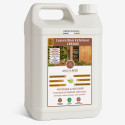
Do not confuse a comfortable working temperature with the permitted range specified in a product's instructions. For example, the technical information for Terrace Wood Saturator ST600 specifies an ambient temperature of +10 to +35°C. Other formulations may have different limits.
| Conditions | Practical advice | Precaution |
|---|---|---|
| Below 10°C | Generally postpone application. | Drying may be slow; always check the product's minimum temperature. |
| 10–15°C | May be suitable for some products. | Watch for dew and falling temperatures later in the day. |
| 15–25°C | Often favourable if the wood is dry. | Still check sun exposure and the weather forecast. |
| 25–35°C | Possible with certain products, with precautions. | Wood in direct sunlight can be much hotter than the air. |
| Above 35°C | Avoid application unless the product expressly permits it. | Never exceed the maximum temperature in the instructions. |
2. Why should you also check the wood temperature?
Dark decking exposed to direct sunlight can become much hotter than the surrounding air. A day at 24°C may therefore be unsuitable if the boards are very hot. Conversely, wood that remained cold overnight may develop condensation even after the air warms up.
A useful first check is to feel the surface and, if possible, use an infrared thermometer. Do not treat wood that is extremely hot, frozen, covered in dew or still wet. If the product instructions specify a surface temperature, that requirement takes priority over general advice.
3. Can you apply a saturator when the air is humid?
High relative humidity generally slows drying. However, the key consideration is the moisture content of the wood itself: timber that feels dry on the surface may still contain water after rain, cleaning or recent pressure treatment.
If in doubt, use a suitable wood moisture meter and compare the reading with the limit stated in the product's technical instructions. Avoid application in fog, dew or condensation, or whenever the surface may become damp again before the finish has dried.
4. How long should it stay dry before and after application?
Do not apply a wood saturator in the rain or onto wet timber. When planning your work, a stable 24–48-hour rain-free weather window is a reasonable precaution, but it is not a guaranteed rain-resistance time for every product.
Distinguish between three periods: the time needed for the wood to dry before application, the period during which the finish must be protected from rain after application, and the time before the surface can be used again. These periods are not necessarily the same and should be checked in the instructions for your saturator.
After cleaning or rainfall, wait until the timber is genuinely dry rather than relying on a fixed number of hours.
5. Why should you avoid direct sunlight?
Strong sunlight heats decking boards quickly and can make the product dry too rapidly on the surface. It then becomes harder to spread evenly, increasing the risk of lap marks and colour variations.
Choose a shaded area or a bright but overcast day, with no rain expected. In summer, you may work early in the morning once the dew has disappeared, or when the boards are no longer hot, provided there is enough drying time before nightfall.
6. How long does a wood saturator take to dry?
Drying time depends on the product, wood species, absorption, temperature and humidity. Touch-dry does not necessarily mean ready for use: decking may require more time before foot traffic is permitted.
Follow the specified waiting time before walking on the surface, moving furniture back or deliberately exposing the treated area to water. Cooler or more humid conditions may extend the drying time.
7. Weather checklist before you start
- Read the instructions: minimum and maximum temperatures, permitted moisture, drying and return-to-use times.
- Check the forecast: avoid rain, fog, extreme heat and the risk of dew during drying.
- Inspect the wood: it should be clean, dust-free, sufficiently dry and free from incompatible old finishes.
- Check the surface: it should be neither excessively hot in sunlight nor cold enough for condensation.
- Prepare the work area: apply in the shade, along the grain, in an even coat without excess product.
- Allow for drying: do not use the deck too early, and keep monitoring the weather.
FAQ: weather and wood saturator application
Can you apply a wood saturator at 10°C?
Some products allow this, including Terrace Wood Saturator ST600, whose permitted ambient temperature range starts at +10°C. The wood must also be dry and conditions must remain suitable for drying.
Can you apply a wood saturator at 30°C?
It depends on the product instructions. Even if the air temperature is permitted, avoid direct sunlight and make sure the timber is not excessively hot.
Can you treat wooden decking in midsummer?
Yes, provided the air and surface conditions comply with the product instructions. Choose shaded periods and avoid peak heat.
Can you apply a wood saturator in autumn?
Yes, if the wood is dry, temperatures are compatible with the product and no problematic rain or dew is expected during drying.
How long should you wait after rain?
There is no universal waiting time: wood species, board thickness, ventilation and weather all influence drying. Check that the wood is sufficiently dry before treatment.
What if it rains after application?
Allow the surface to dry without rubbing it immediately, then inspect the finish once dry. If marks appear, consult the manufacturer's instructions before attempting a repair.
Can you apply a wood saturator in the evening?
It may be possible if the wood is dry and there is enough time for the finish to dry before temperatures fall and dew forms. In practice, late evening is often less suitable.
What is the difference between touch-dry and ready for foot traffic?
Touch-dry means the surface no longer feels wet. Ready for foot traffic means the deck can be used again; this may take longer.
Choose a saturator suited to your wood
For decking, cladding or garden furniture, explore the available finishes and check each product's instructions for its exact application conditions.
Explore Anova Bois wood saturators →In summary: temperature alone does not guarantee a successful application. Always check both the air and wood temperature, moisture, rain forecasts, sun exposure and drying time. The instructions for the chosen saturator remain the definitive reference for application limits.