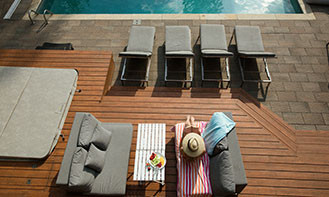
Wood brings incomparable charm to our decks, cladding, and outdoor furniture. But when faced with harsh weather conditions — UV rays, rain, frost, and humidity —, this living material degrades rapidly: it dries out, cracks, and eventually turns gray.
To protect it without altering its beauty, wood saturator is the ideal solution. Unlike traditional finishes that form a film at risk of cracking, it deeply nourishes the wood fiber while preserving the natural grain and feel of the wood.
What is a wood saturator?
To fully understand what a wood saturator is, one must analyze the biology of wood and its behavior when exposed to external aggressive elements. Wood is composed of networks of capillaries, pores, and continuous fibers that naturally regulate moisture. When a finishing product is applied to wood, there are two main, diametrically opposed modes of action: film-forming action (which stays on the surface) and impregnating action (which penetrates deep into the core).
Comparison of modes of action
Film-forming finish
Stain, Varnish, Paint
Film deposited on the surface
- Traps water inside the wood
- Cracks and peels
- Complicated renovation (sanding)
- Longer application time
Impregnating finish
Anova Bois Saturator
Product absorbed into the fibers
- Lets the wood breathe
- Does not peel
- Easy renovation
- Single-coat application
Le Saturateur : L'Imprégnation nourricière non filmogène
A saturator is an extremely fluid finishing product, derived from natural resinous oils and fine resins in aqueous suspension. Its main role is to infiltrate by capillary action deep into the heart of the wood pores, fill microscopic cavities, and "saturate" the fiber with water-repellent and nourishing agents.
Once the pores are saturated and the product is set:
- Rainwater or water splashes can no longer penetrate the inside of the wood. Water slides off in beads (immediate water-beading effect).
- The wood remains porous to water vapor: it "breathes". Internal wood moisture can evaporate without creating underlying pressure.
- There is no surface film. The wood retains its raw, matte, natural look, and warm feel.
- Being free of a rigid film, the saturator undergoes natural weathering evenly over time. It never cracks, peels, or flakes under any circumstances.
The Wood Stain and the Varnish: The Film-Forming Finishes
Wood stain and varnish are thicker resins designed to form a flexible or rigid protective film on top of the wood. While these finishes are highly effective on sheltered vertical joinery (such as windows or front doors), they cause immense problems outdoors on exposed structures:
- On horizontal surfaces (decks, pool copings): Wood stain is strongly discouraged. Foot traffic, friction from shoes, moving chairs, and standing water tear through the stain film. Water seeps beneath the film, causing blistering, wood bluing under the varnish, and dramatic peeling.
- Renovation issue: When the stain or varnish flakes off, it is impossible to apply a new coat over the flaking areas. The only solution is to completely strip or sand the entire project back to bare wood using a belt sander—a grueling, noisy, dusty, and costly task.
The traditional wood oil
Linseed oil or raw vegetable oils are older generation non-film-forming products. While the principle of impregnation is similar, raw vegetable oil presents serious disadvantages outdoors:
- It dries very slowly and remains greasy and sticky, attracting dust, pollen, and pollution.
- It oxidizes under solar UV rays within a few months, causing pronounced darkening of the wood and the appearance of surface mold.
- It requires very frequent reapplications (every 3 to 6 months).
- Wiping off excess product is an essential step, making the application process longer and more demanding.
For more information, feel free to consult our ultimate guide "Saturator or Wood Stain, which one to choose for exterior woods?"
WHY USE A WOOD SATURATOR?
Pour évaluer objectivement la pertinence du saturateur dans le cadre de vos projets, voici une synthèse détaillée de ses atouts majeurs et des contraintes à anticiper.
The Major Advantages of the Wood Saturator
- Complete preservation of wood authenticity: Unlike paint, which masks the material, a saturator is a transparent or semi-transparent finish that highlights the grain, growth rings, knots, and natural texture of the wood, regardless of the chosen shade.
- Total absence of peeling: Since there is no surface film, it is physically impossible for a saturator to peel, flake, or chip due to frost, heat, or foot traffic.
- Unmatched ease and speed of maintenance: When the protection wears down after one or two years of exposure, no sanding, stripping, or sandblasting is required. A simple prior cleaning with Black Soap SN800 followed by the application of a maintenance coat is all it takes to 100% regenerate the protection and revive the color.
- Reinforced water-repellent and oil-repellent action: By blocking liquid water penetration, the saturator prevents repeated dimensional changes in the wood (swelling from humidity and shrinking during drying), which cause warping, cupping of deck boards, and the appearance of cracks or splits.
- Safety on decks and pool surrounds: Being non-film-forming, the saturator does not make the surface slippery when wet, ensuring optimal safety around pools.
- Modern water-based formulations: Wood saturators are formulated with a water base, free of harsh petroleum solvents. They emit no strong odors, dry quickly, and allow application tools to be cleaned with plain water, protecting both the environment and user health.
The Limitations of the Wood Saturator
- Maintenance frequency: Due to the absence of a rigid protective film, the saturator wears away naturally under weathering. Maintenance needs to be planned more regularly than for facade paint. On average, a maintenance coat is required every year on a heavily used horizontal deck, and every 2 to 4 years on vertical siding.
- Rigor of initial preparation: The saturator must be applied to perfectly clean wood free of any old film-forming finishes. Some new lumber leaves the mill with a very tight surface, exhibiting a light "mill glaze." This smooth surface, along with wood dirt or contamination, prevents the saturator from penetrating properly. Additionally, wood density varies significantly from one species to another; this difference in structure and porosity directly impacts the wood's absorption capacity.
UV Protection Mechanism: Tinted VS Clear
Clear Saturator
UV Light / Direct Sun
UV energy passes through the clear
protection and oxidizes the lignin
- Excellent water protection
- Limited UV protection
- More frequent maintenance
Tinted Saturator
UV Light / Direct Sun
Mineral pigments absorb and
reflect radiation
- Excellent water protection
- Reinforced UV protection
- Extended durability
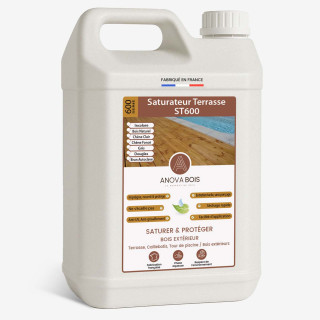
Exotic Wood Saturator SBE600 Matt, Colourless or Tinted- Wood Terrace
Quick view
Quick view
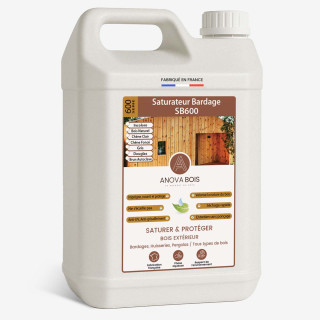
Siding Saturator SB600 - Douglas, Larch, Red Cedar & Other Woods
HOW TO CHOOSE THE RIGHT WOOD SATURATOR?
Faced with the abundance of products on the market, it is essential to base your choice on measurable technical criteria rather than simple marketing promises. Wood is not a uniform material. Density, resin content, moisture level, initial porosity, and mechanical wear vary dramatically from one species or structure to another. Applying a low-end universal saturator across all your woodwork is the fastest way to get disappointing results. This is why Anova Bois has developed specialized, custom-tailored formulas for every situation.
The 5 Fundamental Technical Criteria
To evaluate the professional quality of a wood saturator, analyze these 5 core pillars:
- Water-based phase: Eliminates toxic VOCs and the yellowing typical of solvent-based formulas. It provides fast drying, easy tool cleanup, and safe application without compromising on performance.
- Dry matter (solid content) ratio: Indicates the amount of resin and oil remaining in the wood after evaporation. A high solid content guarantees dense, long-lasting nourishment.
- Wipe-free penetration: Fluid formulas applied in thin coats penetrate directly into the wood, eliminating the tedious task of wiping down board by board.
- UV resistance through pigmentation: Fine mineral pigments provide uniform sun protection within the core of the wood without creating an opaque film.
- Ease of maintenance: The product should wear down through natural erosion, allowing direct reapplication without prior sanding.
Product Range Comparison Table
Here is the summary table of the eco-friendly Anova Bois wood saturator range:
Full Range & Product Features
| Product Name | Application & Wood Species | Finish & Available Shades | Number of Coats | Customer Rating |
|---|---|---|---|---|
| Deck Saturator ST600 | Softwood decks (Pine, Douglas Fir, Larch) | Matte — Clear + 6 available shades | 1 thin coat |
★★★★★
(4.9/5)
|
| Siding Saturator SB600 | Softwood siding, shutters & fences | Matte — Clear + 6 available shades | 2 thin coats |
★★★★★
(5/5)
|
| Garden Furniture Saturator SJ600 | Outdoor furniture & patio sets | Matte — Clear + 5 available shades | 2 thin coats |
★★★★★
(4.8/5)
|
| Exotic Wood Saturator SBE600 | Exotic wood decks & siding (Ipe, Teak) | Matte — Clear + 4 available shades | 1 coat for decks / 2 for siding |
★★★★★
(4.9/5)
|
| Pressure-Treated Wood Saturator SBA600 | Pressure-treated exterior wood | Matte — Single adjusted shade | 1 to 2 coats |
★★★★★
(5/5)
|
If you would like to learn more about maintaining a specific wood species, feel free to read our articles "How to maintain Douglas fir wood?" or "Protecting a Cumaru deck".
HOW TO APPLY A WOOD SATURATOR?
The quality of the final result and the longevity of your protection depend 50% on the quality of the product used, and 50% on the rigor of the preparation and application. Applying an excellent wood saturator on poorly prepared wood or under bad weather conditions will inevitably lead to technical failure.
Ideal weather conditions for application
The drying and penetration of the saturator into the core of the wood pores are governed by the thermal and humidity conditions of the ambient air and the material.
Ideal Weather Conditions
| PARAMETER | RECOMMENDED RANGE |
|---|---|
| Air Temperature | Between +10°C and +30°C |
| Wood Temperature | Between +10°C and +25°C |
| Sunlight Exposure | In the shade or overcast non-rainy weather |
| Wood Moisture Level | < 18% (Perfectly dry wood) |
| Weather Forecast | No rain for at least 48 hours |
Crucial surface preparation
A saturator can only penetrate if the wood surface is free of any obstruction. Depending on the condition of your wood, a specific preparatory treatment is mandatory.
Preparation Protocol According to Wood Condition
| WOOD CONDITION | REQUIRED PREPARATION ACTION |
|---|---|
| UV-Greyed Wood | Anova Bois Wood Brightener DG105 |
| Blackened / Stained Wood | Anova Bois Cleaner N100 or Cleaner N140 (Concentrate) |
| Old Stain / Varnish | Chemical stripping or full sanding down to raw wood |
| Dull Previous Saturator | Simple cleaning with Cleaner N100 |
| New Machined Wood | Wait 3 to 6 weeks |
Exact Application Method: The Golden Rule
Applying a saturator differs from traditional painting. It is not about "applying a thick coat," but rather about "allowing the liquid to be absorbed by the wood."
The Anova Bois Golden Application Rule
On Decks
(HORIZONTAL)
Single thin coat
Evenly spread with a spalter brush
- Complete absorption
- No glossy buildup
- No sticky residue
On Siding & Furniture
(VERTICAL)
- 1st coat: initial penetration
- Interval: between 2 and 24 hours
- 2nd coat: final saturation
Step-by-Step Protocol for DECKS
- Mixing: Shake the saturator container very vigorously for at least 2 minutes to re-suspend the mineral pigments and resins thoroughly.
- Application: Pour the saturator into a container and saturate your spalter brush or roller. Apply the saturator board by board (or 2 to 3 boards at a time), following the direction of the wood grain along their entire length.
- Spreading: Apply A SINGLE THIN COAT. Spread and stretch the product as much as possible. The wood must absorb the liquid. Never leave puddles or excess product accumulated in the grooves of the deck boards.
- Smoothing: If any product remains on the surface, go over it again with a spalter brush to redistribute the excess and smooth out the coat.
- Drying: Allow to dry for 24 hours before allowing light foot traffic, and 48 hours before placing patio furniture back in position.
Protocole Pas-à-Pas pour BARDAGES & MOBILIER
- Mixing: Shake the container vigorously.
- First Coat: Apply a first thin coat working from top to bottom in the direction of the wood grain.
- Second Coat: Allow the product to penetrate for about 2 to 4 hours. As soon as the wood loses its wet appearance, apply the second thin coat to fully saturate the wood fiber.
- Drying: Allow to dry for 48 hours away from dust.
Garden furniture saturator SJ600 - Tables, Chairs & Outdoor Wooden Furniture
If you would like more details on how to apply a wood saturator, check out our guide "Our tips for applying a wood saturator"
Maintenance & FAQ
To complete this ultimate guide, here are the technical answers to the most frequently asked questions on search engines regarding wood saturators.
• On a heavily used horizontal deck, renewal is required on average every 1 to 2 years.
• On vertical cladding, protection lasts on average 3 to 5 years.
Find all the information in "When to apply a saturator on a wooden deck?" .
Simply dust the surface or wash it with Anova Bois N100 Cleaner to remove accumulated dirt. Once the wood is dry, apply a new thin coat of saturator directly to rehydrate the fibers.
Find all our advice on applying a wood saturator in this guide .
• Older-generation solvent-based saturators: They use petroleum solvents, emit high amounts of VOCs, pollute the air, and require chemical solvents (mineral spirits) for cleanup.
This also occurs if the application was done in direct sunlight on hot wood. On decking, always make sure to apply a single, very thin, well-spread coat.
Find more information in the guide "Sticky deck after applying a saturator: what to do?" .
This delay gives sun and rain time to remove mechanical "mill glaze" and naturally open the fiber pores. This is especially essential for exotic woods treated with Exotic Wood Saturator SBE600.
The raw grain and natural grip of the wood remain fully preserved, ensuring perfect barefoot safety on pool decks.
However, to achieve an even finish and force the product into the pores, it is imperative to smooth it with a flat brush (spalter) immediately after spraying. That is why it is highly recommended to use this technique with two people (one spraying, one smoothing).